
Ask a learner to say photograph with the stress on the second syllable – pho-TO-graph – and there’s a good chance a native speaker won’t recognise the word at all. Shift the stress to the third syllable of photographer – pho-to-GRAPH-er instead of pho-TOG-ra-pher – and the same thing happens. Word stress is central to how words are identified in English.
Despite this, word stress rarely gets the attention it deserves in EFL lessons. Teachers tend to focus on individual sounds – the /θ/ in think, the /ɪ/ versus /iː/ distinction — while stress patterns get mentioned in passing or corrected only when a problem becomes obvious. This article makes the case for taking word stress more seriously, and gives you practical ways to teach and work with it in the classroom.
Why word stress matters so much
When a learner puts the stress on the wrong syllable, two things tend to happen. First, the vowel quality changes. In English, unstressed syllables very often contain the schwa – the neutral, mid-central vowel sound /ə/ found in words like camera (/kæmərə/) or relative (/relətɪv/). When a learner stresses the wrong syllable, they’re not just moving an emphasis – they’re changing the vowel sounds across the whole word, and the result can be unrecognisable to a native speaker’s ear.
Second, and less obviously, wrong word stress affects listening comprehension. Learners who haven’t internalised English stress patterns often can’t recognise words when a native speaker says them at natural speed, because the stressed syllable they’re listening for sounds different from what they’ve practised. Teaching word stress isn’t just about production – it directly supports listening too.
Making stress visible in the classroom
The first challenge with word stress is making it visible. You can write a word on the board and learners can see it, but stress is auditory, and learners need to see it represented visually as well as hear it.
The most widely used technique is the stress dot or circle system. When you write a word on the board, you mark the stressed syllable with a large circle and unstressed syllables with smaller ones, placed above or below the word. So photograph would appear as ● ○ ○ and photographer as ○ ● ○ ○. This system is quick, consistent, and – once learners are used to it – instantly readable. Most published and online dictionaries also mark primary and secondary stress clearly, so it’s a transferable skill too.
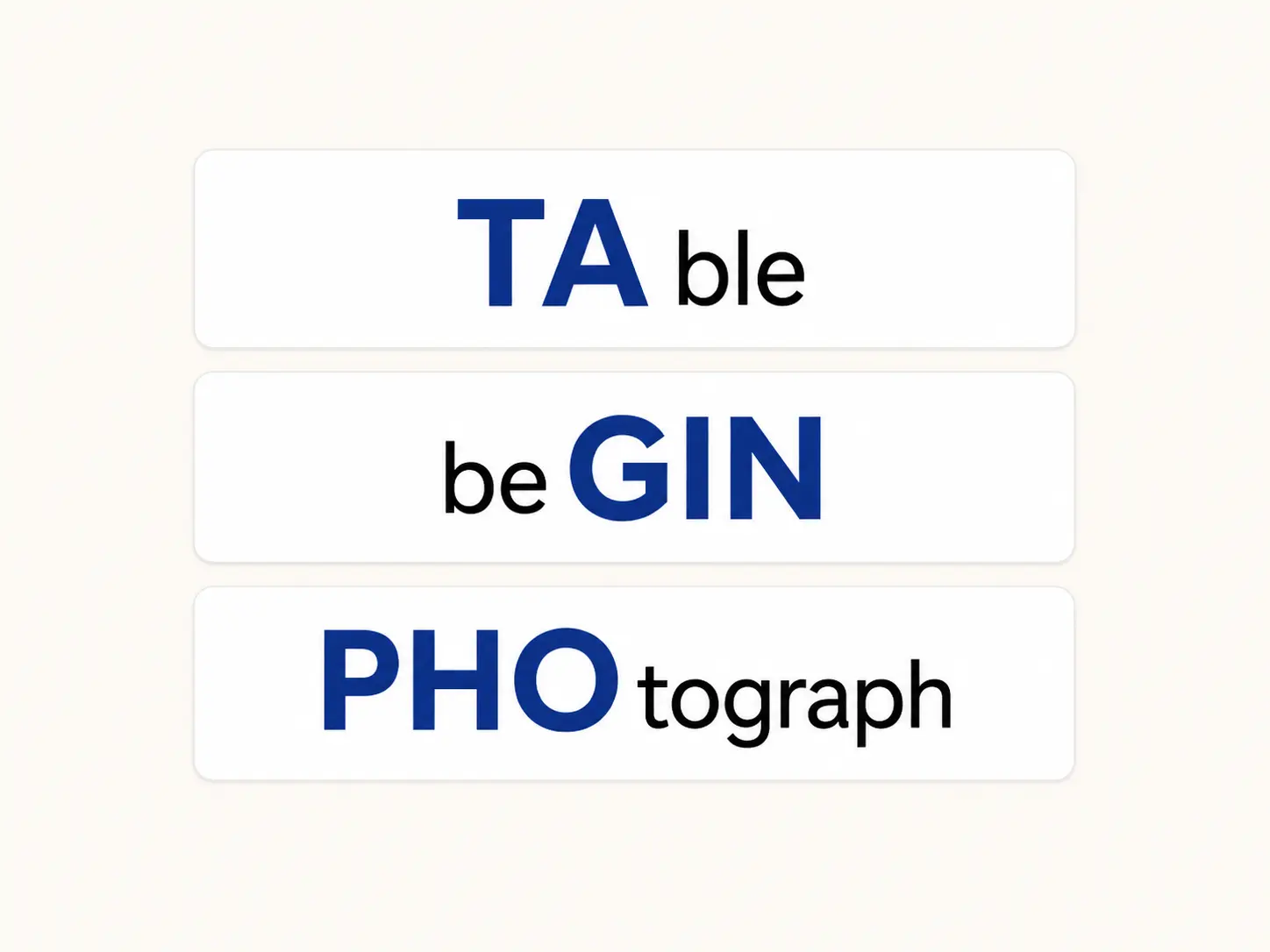
Some teachers use capital letters for the stressed syllable directly in the word: PHO-to-graph, pho-TOG-ra-pher. This is quicker to write and some learners find it more intuitive, though it doesn’t distinguish as neatly between stressed and unstressed syllables as the circle system does.
Physical gestures also work well. Tapping the stress pattern on your hand, clapping it, or bouncing slightly on the stressed syllable gives learners a kinaesthetic sense of where the weight falls. This is especially useful during drilling – learners can tap along as they repeat, which keeps the stress physically grounded rather than just something they’re trying to remember.
When to teach word stress
Teach word stress every time you introduce new vocabulary – don’t save it for a dedicated pronunciation lesson that may never come. Every time you put a new word on the board, the stress pattern is part of what you’re teaching, just as essential as the meaning, the spelling, and the grammar.
In practice, this means:
- When you write a new word on the board, mark the stress at the same time.
- When you drill the word, model the correct stress clearly in your own pronunciation and listen for it in learner repetitions.
- When a learner gets the stress wrong during a drill or in open class, address it – not necessarily at length, but clearly enough that they notice and correct.
It’s also well worth coming back to stress when learners meet word families. The photograph / photographer / photographic family is a good example: the stress shifts with each new form, following a pattern that applies to many similar word families in English. Drawing attention to these shifts deliberately, rather than hoping learners pick them up on their own, is time well spent.
Some useful patterns
There are some patterns in English word stress that are genuinely teachable. They’re not absolute rules – English has too many exceptions for that – but they’re reliable enough to be useful.
Two-syllable nouns vs verbs
Two-syllable nouns and adjectives tend to stress the first syllable: TAble, OFfice, HAppy, CLEver.
Two-syllable verbs tend to stress the second: reLAX, enJOY, deCIDE.
This distinction also gives us the well-known noun/verb stress shift in pairs like:
- REcord (noun) / reCORD (verb)
- PROtest (noun) / proTEST (verb)
- IMport (noun) / imPORT (verb)
Suffix patterns
Words ending in -tion, -sion, -ic, -ical, or -ity almost always stress the syllable immediately before the suffix:
- inforMAtion
- eLECtric
- ecoNOMical
- comMUNity
This is a reliable pattern, and learners can apply it with confidence to new words they come across with these endings.
Compound nouns
Compound nouns in English typically stress the first element: BLACKboard, HANDbag, WILDlife, DOORknob. This contrasts with adjective + noun phrases, where the stress falls on the noun: black BOARD (a board that happens to be black) differs from BLACKboard (the classroom object). The distinction is subtle but real, and useful at higher levels.
The limits
Outside these tendencies, it’s honest to tell learners that English word stress is often unpredictable, and that checking the stress of new words in a dictionary or online is a genuinely useful habit. Most learner dictionaries mark stress clearly, and encouraging learners to notice and record stress patterns when they meet new vocabulary does far more good than trying to derive every word from a rule.
Drilling word stress
Drilling is the most direct way to help learners internalise stress patterns, and it doesn’t need to be mechanical or boring. Here’s what makes it work well for word stress specifically:
- Model clearly. When you say the word, make the stressed syllable genuinely prominent – louder, slightly longer, with clear vowel quality. Don’t underplay it out of embarrassment about exaggerating. Learners need to hear the contrast between stressed and unstressed syllables clearly, and natural connected speech often makes that contrast harder to hear, not easier.
- Use back-chaining for longer words. Rather than drilling photographer from the beginning, start from the stressed syllable and build outwards:
TOG → TOG-ra → pho-TOG-ra → pho-TOG-ra-pher
This keeps the stress anchor point consistent and produces more accurate results than drilling from the start of the word. - Contrast minimal pairs. Drilling REcord and reCORD back to back is more memorable than drilling either in isolation, because the contrast makes the shift audible and concrete.
- Keep it short. Two or three repetitions per learner is enough to address a stress issue. Prolonged drilling of a single word can give you diminishing returns and a slightly surreal atmosphere.
Working with the schwa
The schwa (/ə/) is the most common vowel sound in spoken English, and it’s directly connected to word stress. It appears in unstressed syllables where the full vowel sound gets reduced. In photographer, three of the four syllables contain a schwa: /fətɒɡrəfə/. In banana, two do: /bənɑːnə/.
Most learners don’t produce schwas naturally, because in their written form the unstressed syllables look like they should have a full vowel sound. A learner reading photography might well give each written vowel too much value, something like /fəʊtɒgræfiː/, which sounds laboured and non-native even if every consonant is perfect.
Teaching the schwa explicitly, and linking it to word stress, helps learners understand why unstressed syllables sound the way they do. You don’t need to go deep into phonetics – just make the connection clear: when a syllable isn’t stressed in English, the vowel often becomes a schwa, regardless of what letter is written there. That insight changes how learners approach pronunciation more broadly.
A useful classroom activity is to take a familiar word and ask learners to mark where the schwas are before they say it:
- Camera: three syllables, stress on the first, schwa in the second and third – /kæmərə/ (or just two syllables, /kæmrə/, depending on the speaker).
- Problem: two syllables, stress on the first, schwa in the second – /prɒbləm/. Working through a short list of familiar words this way builds awareness without requiring learners to memorise a lot of phonetic symbols.
Correcting stress errors in the classroom
When a learner gets word stress wrong, simply repeating the word back correctly often isn’t enough, as they may not have noticed what changed. Here are some approaches that can work better:
- Tap or clap the correct stress pattern before the learner repeats, so they have a physical anchor for where the stress falls.
- Write the circle pattern on the board and point to the correct stressed syllable, making the correction visual.
- Say both versions – the learner’s version and the correct one – so the contrast is clear: “pho-to-GRAPH-er… or pho-TOG-ra-pher – which one?”
- Ask the learner to find the stressed syllable themselves before they repeat, rather than just giving them the answer.
As with all pronunciation correction, timing is important. During a drill or controlled practice, correcting stress directly is fine and expected. During a fluency activity, note the error and come back to it afterwards rather than interrupting communication to fix a pronunciation point.
A classroom activity: stress sorting
One activity that works well at intermediate level and above is stress sorting. Give learners a list of ten to fifteen words – drawn from recent lessons or a vocabulary set they’re working on – and ask them to sort the words into groups based on their stress pattern, using the circle notation. So a three-syllable word with stress on the first syllable goes in the ● ○ ○ column, a three-syllable word with stress on the second goes in the ○ ● ○ column, and so on.
Learners work in pairs, which generates discussion about where the stress falls. You monitor and deal with disagreements. Feedback involves confirming the groupings, drilling any words that caused difficulty, and, if the words happen to share a stress pattern, noting why: are they all nouns? Do they share a suffix?
It’s simple to set up, doesn’t need any materials, and gets learners actively thinking about stress patterns rather than just hearing about them.
A final thought
Word stress is one of those areas where a small amount of teaching time makes a big difference. Learners who’ve been taught to notice and mark stress patterns, who can use the circle system, and who’ve drilled key vocabulary with the stress clearly modelled tend to be significantly more intelligible – not because their grammar has improved, but because the rhythm of what they say is closer to what listeners expect. That’s a practical, achievable goal for any level, from beginner upwards.
References
- Celce-Murcia, M., Brinton, D. and Goodwin, J. (2010) Teaching Pronunciation: A Course Book and Reference Guide (2nd ed.). Cambridge University Press.
- Kenworthy, J. (1987) Teaching English Pronunciation. Longman.
- Roach, P. (2009) English Phonetics and Phonology (4th ed.). Cambridge University Press.