

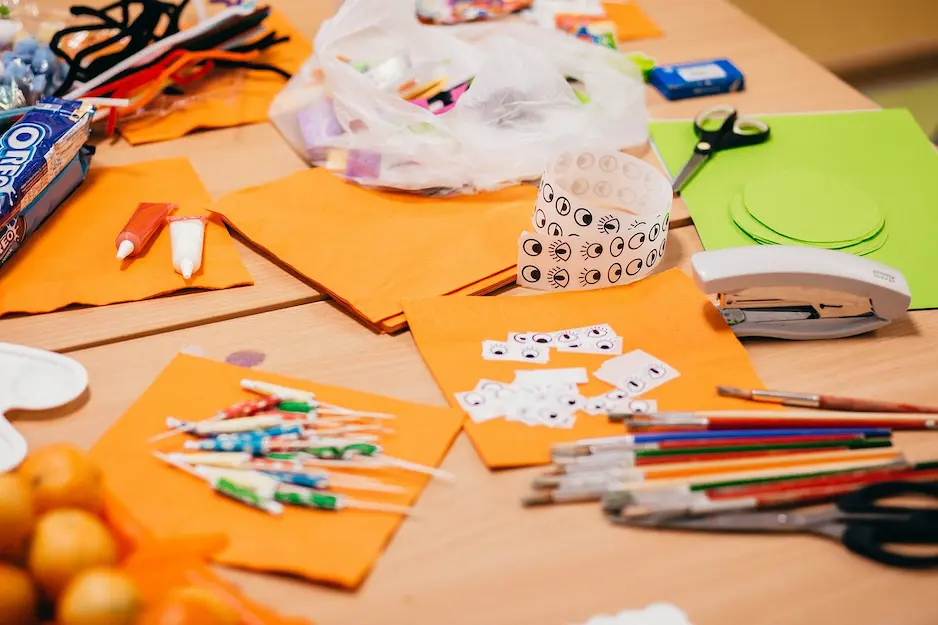
Art isn’t always the first thing teachers think of when planning an English lesson, but it should be much higher on the list. Children (and many adults) are naturally creative, respond strongly to images, and often express themselves more confidently when the focus shifts away from language for its own sake. A simple drawing, painting, or picture can lower anxiety, spark curiosity, and open the door to real communication.
You don’t need to be an artist. You don’t need a specialist art room. And you don’t need expensive materials. What you do need is a willingness to bring in images, colour, and a little creativity as a bridge to language. That’s more than enough.
Here are some practical, classroom-tested ideas for using art in ways that genuinely support language learning, and make your lessons a little more fun along the way.
Why use art in language teaching?
Visual input is powerful for language learning. Research in second-language acquisition suggests that:
- pictures can reduce cognitive load, helping learners process meaning more easily (Paivio’s Dual Coding Theory)
- visuals often increase recall and retention, especially for concrete vocabulary (Mayer, Principles of Multimedia Learning)
- creative tasks can promote motivation and curiosity – essential for Young Learners
- a non-linguistic starting point can help lower anxiety, making learners more willing to speak (Krashen’s Affective Filter Hypothesis)
Art is also inclusive. Learners who may struggle with traditional language exercises often shine when given the chance to draw, create, or respond to images.
Ways to use art meaningfully in the ESL classroom
1. Exploring colours through real contexts
Most colour lessons stop at red, blue, yellow and green, but art encourages learners to move beyond the basics and discover more descriptive colour language:
- sky blue
- forest green
- dusty pink
- burgundy
- lemon yellow
- charcoal grey
Use a colour wheel, paint cards from DIY shops or even car brochures (these are surprisingly useful – car manufacturers specialise in creative colour descriptions).
Activity idea: “Colour up the scene”
Show learners a black-and-white picture (for example, a street, an office or a classroom). Ask them to describe what they can see.
Then show the same picture in colour. Ask them to describe it again. How do their descriptions change? You’ll often hear richer language emerging as learners respond to the colours.
2. Teaching shapes and everyday tools
Art provides a natural context for teaching shapes (circle, square, triangle, rectangle, oval) and everyday tools learners already know: pencils, erasers, rulers, brushes, markers and so on.
Activity idea: “Shape detective”
Project or display an artwork (abstract works are especially good for this). Ask learners to identify all the shapes they can see. Start with simple shapes, then move on to more detailed prompts:
- “Find a triangle inside a circle.”
- “Find a shape that looks like a leaf.”
- “Where can you see parallel lines?”
This builds vocabulary while also stretching their ability to describe position and detail.
3. Art books and museum images for vocabulary building
A single painting can be the starting point for all sorts of things, for example:
- describing people
- learning adjectives (crowded, peaceful, dark, bright, modern, traditional…)
- talking about mood and feelings
- practising verbs of movement
- comparing two scenes using comparatives and superlatives
Even looking through an art book or museum website and reading short captions can become a mini reading activity.
Activity idea: “Zoom in”
Show learners a very small “zoomed-in” section of a painting and ask them to guess:
- What is the full picture?
- Where might this be?
- Who or what do they think is in the scene?
After some discussion, reveal the full image and compare their ideas with the reality.
Activity idea: “How does it make you feel?”
Choose four or five artworks with very different moods – bright and lively, dark and dramatic, abstract and confusing, calm and peaceful. Ask learners to describe each one using evaluative adjectives such as exciting, dull, disturbing, brilliant, powerful or calming. Encourage them to explain why they chose each word. This builds descriptive language, opinion-giving, and useful phrases such as “I think it looks…”, “It feels…”, and “To me, it seems…”.
4. Digital art for tech-confident learners
Simple drawing apps, like Paint, Sketchbook, Procreate Pocket, or any built-in app, can introduce learners to:
- digital art vocabulary (brush, layer, opacity, eraser, fill)
- shape, line and colour language
- instructions and imperatives (“Draw a small circle”, “Now fill it with blue”)
Using the built-in tutorial of a drawing app, and having learners follow the simple on-screen steps for a few minutes, exposes them to terms such as select, rotate, zoom in, undo, drag, tap, swipe and blend – a natural mix of verbs, nouns and imperatives that they pick up without even realising it.
Activity idea: “Follow my instructions”
Put students in pairs, sitting back-to-back. One student creates a simple picture using a drawing app. They then give oral instructions while their partner tries to recreate it without seeing the original. At the end, they compare the two images.
This is excellent for practising imperatives, prepositions of place and careful listening.
5. “Show and tell” with personal artwork
If you teach in a setting where art is valued culturally, invite learners to bring in a piece of art they like:
- a drawing or painting
- a craft from school
- a postcard or small print
- a photo of a mural or sculpture
- something made by a family member
Each learner can then give a short “show and tell”:
- What is it?
- Who made it?
- Where does it come from?
- Why do you like it?
Because the topic is personal and meaningful, students often speak more naturally and with greater confidence.
If you want to extend the activity, turn it into a short writing or research task. Learners can write a paragraph about the artist, the origin of the artwork, or its cultural significance, or simply explain why the piece matters to them personally.
6. Using art for speaking practice
Activity idea: “Mystery picture”
Choose four to six different artworks. Put students into groups and give each group one picture. They discuss it together and prepare a description.
Then regroup the students so that they are now with people who have seen different pictures. Each student describes their artwork to the new group without showing it. The others listen and choose which picture they think it is from a set of images on the table or on the board.
This builds descriptive language, listening for detail and useful language such as “Is it the one with…?” and “I think it’s…”
7. Using art for writing practice
Art makes an excellent prompt for writing tasks. You can ask learners to:
- describe a room or landscape based on a painting
- write a dialogue between two characters in the picture
- create a comic strip with simple drawings and speech bubbles
- design a book cover and write the blurb
- write a story inspired by an image
Activity idea: “Scroll stories”
Give students several small pieces of paper or pre-drawn panels. They write and illustrate a short story, one part in each panel. Then they tape the panels together to make a scroll.
In the next lesson, students untie or unroll their scrolls and read their stories to the class, showing the pictures as they go. This combines sequencing, creativity and public speaking.
8. Local art as a community resource
Where possible, use what you have around you:
- local artists and craftspeople
- small galleries or community art centres
- murals, statues or public art
- art displays in the school itself
You may find someone willing to talk to your class about their work or even demonstrate a technique. This can be a memorable real-world listening and speaking experience for your learners.
9. Integrating art into projects and CLIL
Art fits naturally into CLIL-style projects where learners use English to explore other subjects. For example, you can ask students to:
- design a poster with an environmental message
- illustrate a life cycle or process in science
- create maps for geography projects
- design flags, patterns or symbols connected to different cultures
These tasks give learners a real reason to use language and produce something visual at the same time.
Practical tips for teachers who “can’t draw”
You don’t need to be good at drawing to use art in your classroom. In fact, simple stick figures can be even better than polished illustrations, because they feel more human and often make students laugh.
What matters is:
- willingness to use visual prompts
- enthusiasm and openness to creativity
- clear links between what students see and the language you want them to use
Let go of the idea of producing “perfect” art. The goal is communication, not masterpieces.
Final thoughts
Using art in the ESL classroom isn’t about turning your learners into artists. It’s about giving them another way into language: through colour, line, shape, story and imagination.
Visuals can help learners understand new language, remember vocabulary and express themselves more freely. They make lessons more engaging and inclusive, and they draw on resources that are often already around us – in books, online collections, local galleries and our own students’ creativity.
If you’ve used art in your own classes, I’d love to hear your ideas and experiences.
References
- Paivio, A. (1986). Mental Representations: A Dual Coding Approach. Oxford University Press.
- Krashen, S. (1982). Principles and Practice in Second Language Acquisition. Pergamon.
- Mayer, R. (2001). Multimedia Learning. Cambridge University Press.


16 comments
Maheshi Weerasekara (Sri Lanka)
Excellent article. You are 100% correct. I usually utilize arts in my ELT classroom. It is very easy and fascinating in using arts in teaching almost all four skills. The most interesting thing is the students are delighted in this method of English language learning. Thanks for the fantastic facts you provided!
Dr. Nile Stanley
Thank you for excellent article. I see much potential in using art with storytelling to teach language and literacy.
Marie
Hello! Thanks for this article and the comments. I wonder if you could provide me references of theoretical “scientific” articles showing that art really helps language Learning and showing how that works. Thanks a lot.
PK
I’m also HOD visual arts and we have many esl students and a separate small section of Japanese and Korean school within our main school. I teach art and use ESL resources a lot together with art to ease them into new language acquisition. Also for my research I’m also looking for scientific articles. If any references will be very helpful.
Areen (Israel)
Great subject. I love art and I was wondering how I could use it in my classrooms while I do practical work. You gave me some wonderful ideas. Thanks.
Lawrence Solkoski
I think using art in an ESL class would be great way to get students to open up a bit more and to be more expressive verbally, but there are students who are turned off by visual art, like drawing and painting, they are bored by it.
Desirée (Spain)
Thanks for giving me such original and creative ideas. I’m teaching English as a Foreign Language in Spain. Although I often try to make my classes enjoyable and I like creating projects, sometimes I run out of ideas. I have always liked art and it’s awesome to merge both English and Art in class. I will try some of them! Thanks!”
Karen
Thanks for that, my degree is in art and I have always had a keen interest in teaching english through art. This article was inspiring and now I will feel more confident to use my skills in the classroom.”
Sugitha
A creative and innovative concept to use for an effective classroom lesson. It not only provides a field for ideas to keep aimless, wandering minds of students’ busy but is also an efficient tool to explore English language in a new direction. Thanks for sharing the idea.”
Vicky
This is a great article! I too like to use art in the classroom, especially because I believe that it’s more efficient when trying to learn a new language to understand concepts than to try to translate everything. I usually act out new verbs or draw on the board to show the meaning of new vocabulary. I think the visuals help the students remember the meaning better, and it’s also fun.
Robin
I have used art a lot while teaching English to students in southern Thailand. One lesson the students particularly liked was one in which I had a picture which I did not show the students. Instead I looked at the picture and described to them what was in the picture, and they had to try to reproduce it. For example you could have a picture of a beach or a park with many things going on. An alternative is to give them a cartoon strip you have drawn but leave the story unfinished so they have to complete it. In the next lesson they write a description of what is happening in their version of the cartoon and then read it to the rest of the class. I also do pictures on flash cards which I later give the students a photocopy of and use the whiteboard a lot to illustrate new vocabulary.
Phil
There are 6 artists spread over 3 generations in my family. I am not one of them, however, I do use art in the classroom. I visit galleries and exhibition locally and when on holiday and buy cards of interesting pieces to use in class. I teach business English to business people. The course is very intensive and art works as a great diversion and talking point. 99% of people have an opinion some will see it as pointless, waste of time and money etc , while others will see it as an essential part of any culture. Try contrasting Modern Art with the Traditional, Italian, Asian etc. Asian students often have a great knowledge of European art and can put us to shame. I use it to help give opinion and teach them more direct language than they would normally use. Rubbish, garbage, trash, brilliant, awe inspiring, full of life, colourful, inspirational, soul destroying, disturbing, nauseating, worthless, priceless,… I could go on and on. Adjective heaven. For lower levels simple degrees of love/hate, interest/disinterest can be explored. The main thing is to enjoy it!
Meg
As a teacher of both adult beginning ESL students, and high school middle level ELL students, I find that art is an invaluable way to help students focus on the writing process while appealing to other modalities of learning. Having used graphic realia for years to help bring the words alive, I also find that when they can create a visual to go with a story, or when beginners can create murals/collages with pictures of themes (e.g. food) I get more enthusiastic response, and better overall participation and learning. Two modalities simultaneously are always better than one!
Susan
I use art all the time in my ESL classroom. The one thing you have to be careful of is your students knowledge of the words you are using. I demonstrate and use the words along with what I’m doing and then have them repeat the words. A lot of it for them is memory. They do enjoy doing creative things though at all levels. You don’t have to be an artist to use art! Use the online resources. Crayola.com is a wonderful resource and there are many others”.
Jenny
I taught a Visual Arts ESOL programme for many years in Sydney at an Intensive English Centre. We prepared newly arrived migrant children for the NSW school system and all teachers had dual qualifications in key subjects plus English as a Second Language training.
Art is a wonderful way to teach English and group projects such as murals encourage co-operation and communication between students of all ages. As making art involves many different processes it is excellent for sequencing and following/giving instructions. It is also an effective way to acquire and implement language of description and comparison and, as you have pointed out vocabulary acquisition for the elements of design (shape, size, colour, texture, tone etc.) is so much more enjoyable if done in a practical and hands-on way.
Expressing ideas and feelings through art is also of immense value where students are at the beginning stages of English language acquisition and for many of my refugee students was a form of therapy. It is also a way to respect, explore and share the cultural traditions of different cultures, both of the host country and of the students themselves. I found your article very interesting! Thank you”.
Mel
I’ve used Artrage on Tablet PCs with secondary students a lot, and it really motivates them. Most commonly, I’ve asked them to complete a piece of writing (limerick or haiku works very well) and once they have finished it they can make an illustration using the art software. We then display both the writing and the illustration in a class wiki, or on the wall of the classroom. Of course, this could also be done with paper and art materials, but given that our students are such ‘digital natives’, use of the computer software, plus all of the extra artistic effects it offers, is an important part of the equation”.