What You Need to Teach English in Cambodia
One of the main reasons Cambodia attracts so many new teachers is its relatively open entry requirements. Compared with more regulated TEFL markets in Asia, it’s possible to start teaching legally in Cambodia without jumping through as many hoops. However, that flexibility also means expectations can vary significantly from one employer to another.
Here’s what you need:
- Bachelor’s degree
Unlike countries such as Vietnam, South Korea, or Japan, a Bachelor’s degree is not a legal requirement to teach English in Cambodia. It’s one of the very few countries in Asia where you can teach English without a degree.
- TEFL Certification
A TEFL certificate is the most important qualification for teaching English in Cambodia. Reputable schools expect teachers to have completed an accredited 120-hour TEFL or TESOL course. Aim for one that includes practical teaching experience.
- English proficiency
Fluent non-native English speakers are widely employed across the country, but you’ll need to be able to show that you have a certified English level of C1 or higher, an IELTS score of 7, or equivalent, as well as demonstrating excellent spoken and written English during your job interview.
- Experience
Previous teaching experience is not required. Employers in Cambodia regularly hire first-time teachers, particularly at private language centres.
- Police background check
You’ll need a clean police background check from your home country. This is worth arranging in advance, as it can be trickier to organise once in Cambodia.
How to Choose the Right TEFL Course in Cambodia
Choosing the right TEFL course is one of the most important decisions you’ll make as you prepare to teach in Cambodia, and it can make the difference between struggling to find stable work and feeling confident in the classroom from the very beginning.
For more about choosing a course, see our 6 Questions to Ask When Choosing a TEFL Course.
While entry requirements in Cambodia are more flexible than in some neighbouring countries, schools quickly recognise whether a teacher has been properly trained. A quality TEFL course not only makes your CV more attractive to employers but also gives you the practical skills you’ll need to manage real classrooms.
Here’s what matters most when comparing your options:
- Accreditation and recognition
Your TEFL certificate should be fully accredited and widely recognised by schools in Cambodia and internationally.
- Observed teaching practice
With real students and structured feedback from qualified trainers. Peer-teaching exercises have their place, but nothing replaces standing in front of actual Cambodian learners and adapting on the spot.
- Lesson planning and classroom skills
Make sure the course covers how to design and run engaging, well-structured lessons, with specific attention to managing young learners and large, mixed-ability groups, both of which are common in Cambodian schools.
- Job support
A course that helps you find work after qualifying, through interview coaching, employer introductions, and ongoing advice, is worth far more than one that hands you a certificate and leaves you to figure the rest out alone.
For more about the importance of accreditation, see TEFL Accreditation: What is it and why is it important?.
Both online and in-person TEFL courses are accepted by schools in Cambodia, but taking your TEFL course in Cambodia itself offers some clear advantages:
- Many employers prefer candidates who are already in Cambodia and available to start quickly.
- You can begin building a local network and may even meet potential employers during your course.
Many teachers who take our Cambodia course at School of TEFL have jobs lined up within a week or two of finishing training.
From Training to Teaching in Cambodia: Getting Your First Job
Once you’ve completed your TEFL course, the transition into your first teaching role is often quicker and less formal than in many other TEFL destinations, but it relies heavily on understanding how the local job market works in practice.
Unlike more centralised markets, Cambodia’s teaching jobs are largely filled locally and through personal contact. While vacancies are advertised online, many schools still prefer to meet candidates face-to-face before making a decision. For this reason, being in Cambodia when you apply can make the process significantly easier.
What Employers Are Looking For
Cambodian employers tend to focus less on rigid checklists and more on how a teacher performs in person. Clear spoken English, confidence in front of a class, and a professional, reliable attitude count for a lot.
Many schools place a strong emphasis on flexibility. Teachers who are open to evening or weekend work, split shifts, or teaching mixed-ability classes are often easier to place, particularly at language centres. Experience with young learners is especially valued, as children’s classes make up a large part of the market.
Interviews and Demo Lessons
Interviews in Cambodia are usually informal and practical. You may be invited to a short interview with an academic coordinator or school manager, followed by a brief demo lesson. In some cases this happens on the same day, particularly at language centres that need teachers quickly.
Demo lessons are typically short and focus on whether you can hold a room, deliver instructions clearly, and keep students engaged. Methodology matters less than presence and energy.
Tip: Have a short, adaptable lesson plan in your back pocket at all times. Schools may ask you to teach on the spot, and having something prepared shows you are serious and organised.
How Teachers Commonly Find Work
Most new teachers find work by visiting schools in person. Turning up at a language centre with your CV in hand is still a normal and effective way to introduce yourself in Phnom Penh and Siem Reap, and face-to-face contact often moves things along faster than emailing alone.
Schools also frequently post vacancies in Facebook groups and local expat networks, and recommendations from other teachers can open doors that aren’t advertised publicly.
If you take your TEFL course in Cambodia, your training centre may be able to connect you with trusted employers and point you toward schools that are actively hiring. That kind of local knowledge removes much of the uncertainty from your first job search.
Timing and Building a Schedule
Hiring in Cambodia happens throughout the year, especially at language centres, although recruitment can slow briefly around major holidays such as Khmer New Year. There is no single intake period, which means you can arrive at different times and still find work.
Schools in Cambodia often move quickly once they’re interested in a candidate. Being reachable and able to respond promptly can make a real difference.
Tip: Employers commonly use Facebook Messenger for initial contact, and Telegram is also widely used. Make sure your contact details are clear on your CV and that you can respond quickly to messages.
For more advice on preparing applications and interviews, see TEFL Interview Questions and How to Answer Them.
Visas and Work Permits: What You Need to Work Legally
Cambodia’s visa process is simpler than in most of its neighbours, and the paperwork involved is lighter than what you would face in Vietnam, South Korea, or Thailand. Most schools will help you through the process once you are hired, but understanding the steps in advance makes the transition smoother.
Here’s how the process usually works in practice:
- Enter Cambodia on the appropriate visa
To enter Cambodia, you’ll need either a T-class (tourist) visa or an Ordinary (E-class) visa. If you don’t plan to teach in Cambodia after your course, a T-class visa is sufficient. It’s valid for 30 days and can be extended once for a further 30 days without leaving the country.
- Enter on an Ordinary (E-class) visa if you plan to teach
If you plan to stay and teach in Cambodia after your course, it’s best to enter on an Ordinary (E-class) visa. This visa is also valid for 30 days and (depending on your nationality) can be obtained online, at a Cambodian embassy, or on arrival at the port of entry.
- Extend your E-class visa
Ordinary (E-class) visas can be extended for one, three, six, or twelve months. Six- and twelve-month extensions allow multiple re-entries and make it possible to open a Cambodian bank account, which many employers require.
- Secure a job and arrange your work permit
Once you secure a teaching position, employers in Cambodia often assist with extending your visa and applying for a work permit. The level of support varies depending on the school and your contract, but most reputable employers expect teachers to be properly registered.
- Transitioning from a T-class visa if needed
If you enter Cambodia on a T-class visa and later decide to teach, you may need to leave the country briefly to obtain an Ordinary (E-class) visa before transitioning to a work permit. Some teachers do this via a short border trip, for example from Phnom Penh to the Vietnam border.
The cost of a Cambodian work permit and related visa extension is approximately US $500-$550. This cost is often shared between the employer and the teacher, although arrangements vary by school.
Compared with countries like Vietnam or South Korea, Cambodia’s system involves fewer document legalisation requirements. A university degree and police background check are not always legally required for the visa itself, but many schools will still ask to see them, particularly when applying for longer visa extensions or work permits.
Tip: Bring originals of your TEFL certificate, degree (if you have one), background check, and a supply of passport photos. Not everything will be needed straight away, but having your documents ready avoids delays when a school wants to move quickly.
Note: Visa regulations can change at short notice. Always check official government sources before making travel or work plans.
Teaching Jobs in Cambodia: Where You’ll Work and What You’ll Earn
Cambodia offers several types of teaching work, and the setting you choose shapes your schedule, pay, and day-to-day experience. Contracts here tend to be more flexible and less standardised than in markets like Vietnam or South Korea, and hourly arrangements are common alongside monthly contracts.
A typical working week is 20 to 30 classroom hours, though these are often spread across afternoons, evenings, and weekends rather than packed into a daytime block. Most teachers have at least one full day off, but holidays, sick leave, and other benefits differ widely between schools, so ask about these before signing anything.
- Language Centres
Private language centres cater mainly to children and teenagers after school, as well as adults in the evenings and at weekends. Class sizes are usually smaller than in public schools, often ranging from 10 to 25 students. Salaries are usually around $800-$1,200 per month for teachers working close to full time. While these salaries are modest, living costs in Cambodia are also relatively low.
- Private Schools
Private schools may follow a Cambodian curriculum or a bilingual programme with increased emphasis on English. These schools usually offer more regular daytime hours than language centres, often closer to a traditional school schedule. Some private schools are well organised with clear curricula and support, while others operate more informally. Pay varies widely depending on location, ownership, and expectations, but is generally comparable to language centre work.
- International Schools
International schools offer the highest salaries and most structured working environments, but they are also the most competitive. They follow foreign curricula such as British, American, or IB programmes and usually require a recognised teaching licence and a university degree. Salaries typically range from $1,500-$2,500+ per month, often with additional benefits such as housing allowances, paid holidays, or health insurance.
- NGOs, Educational Projects and Public Schools
NGOs and educational charities play an important role in English education in Cambodia. These roles can be deeply rewarding and offer strong cultural immersion. Pay is often lower than in private schools or language centres, and some positions are voluntary. Facilities and resources may be limited, and placements may be outside major cities. Some foreign teachers also work in public schools, where salaries are typically around $600-$900.
- Private Tutoring
A popular way to add to your school income. Rates run from $10 to $20 per hour, with business English and exam preparation at the upper end. Demand is steady in Phnom Penh and growing in Siem Reap. Before taking on private students, check that your contract and visa arrangements allow it.
Tip: When you get an offer, ask how hours are allocated, what happens when classes are cancelled, and whether you will be expected to travel between sites. A higher hourly rate can look less attractive if your day is broken up by unpaid gaps and long commutes across the city.
When to Apply for Teaching Jobs in Cambodia
There is no fixed hiring season in Cambodia. Language centres operate on rolling enrolment and bring in new teachers as others finish their contracts or move on, which means openings come up throughout the year. If you are already in the country and can start at short notice, you will find opportunities regardless of the month.
The quietest period for recruitment is usually around Khmer New Year (mid-April), when many schools close for one to two weeks. Hiring also slows slightly around Pchum Ben (September/October).
Private and international schools follow a more traditional academic calendar, recruiting mainly in the months before their August or September start, with a smaller window at the start of the calendar year.
Tip: Try not to time your arrival to coincide with Khmer New Year or Pchum Ben if your main goal is to start job hunting immediately. Outside those windows, the market is active year-round.
Living Costs & How Much You Can Save in Cambodia
Cambodia’s low cost of living is a major draw. Salaries are modest, but daily expenses are low enough that most teachers live comfortably, and some manage to save a little each month.
Rent is the biggest item in your budget. A private one-bedroom apartment in Phnom Penh typically costs $200-$600 per month, depending on the neighbourhood and building quality. Central, expat-popular areas such as BKK1 fall at the higher end, while districts further out are significantly cheaper. Sharing a flat is how many new teachers keep costs down while they settle in. In Siem Reap and Battambang, rents are generally lower, though the job market is smaller.
Eating locally is inexpensive. A Cambodian meal from a street stall or local restaurant costs $2-$4. Western restaurants and cafes charge more, typically $8-$12 a meal, and are concentrated in expat and tourist areas. Shopping at local markets keeps grocery costs low, though anything imported carries a markup.
Electricity, water, and internet typically add up to $50-$120 per month. Air conditioning is the main variable: running it heavily in the hottest months can push your electricity bill up noticeably.
Getting around is cheap. Tuk-tuks and ride-hailing apps (Grab and PassApp) cover most short journeys affordably. Some teachers rent a motorbike for $50-$100 per month, which gives more flexibility but comes with genuine safety considerations: roads are unpredictable, and helmets and caution are non-negotiable.
Tip: If you rent a motorbike, use a reputable rental company and check the brakes, tyres, and lights before agreeing to anything. Road conditions and enforcement can be unpredictable, so caution is essential.
On a sensible budget, most teachers can live well on around $1,000 per month. Saving is possible if you keep your lifestyle simple, but Cambodia rewards you more in experience and quality of life than in financial returns.
Bring enough cash to cover your first few weeks: rent deposit, work permit costs, basic setup, and living expenses before your first pay comes in.
Figures above are based on publicly available data sources (actual costs may vary depending on location and lifestyle):
Where You Can Live and Teach in Cambodia
Most teaching jobs in Cambodia are concentrated in a small number of urban centres, with far fewer opportunities available in rural areas. Where you choose to live will have a big impact on the type of work you find, your income, and your overall lifestyle.
The majority of new teachers start in Phnom Penh or Siem Reap, where demand is strongest and the job market is most accessible. Smaller towns and provincial areas can offer a more immersive experience, but jobs are fewer and often linked to NGOs or short-term projects.
Phnom Penh
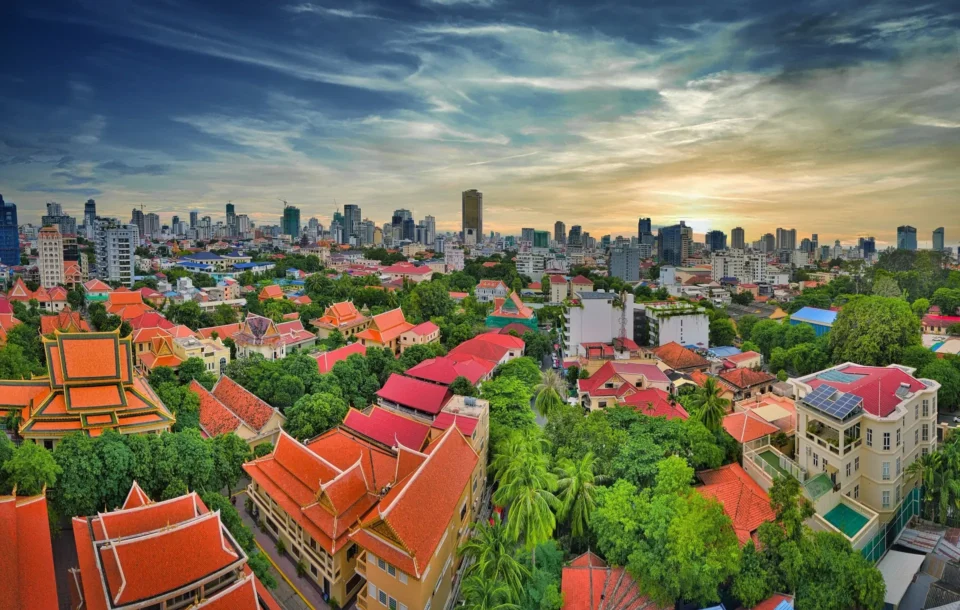
Phnom Penh is Cambodia’s main hub for English teaching jobs and offers by far the widest range of opportunities. Most language centres, private schools, and international schools are based here, and competition is generally lower than in more saturated TEFL markets elsewhere in Asia.
The city is busy, spread out, and constantly developing. Many teachers choose to live close to their main workplace to minimise commuting, as traffic can be unpredictable. Popular neighbourhoods among teachers include BKK1 and BKK3, which are central and expat-friendly, as well as Toul Tom Poung (Russian Market), which has a slightly more local feel with good access to cafes, markets, and schools.
Phnom Penh suits teachers who want the best chance of securing steady work, building a full timetable, and accessing a wider expat community. Living costs are higher than elsewhere in Cambodia, but still modest by Western standards.
Siem Reap
Siem Reap is Cambodia’s second most popular base for English teachers. It’s smaller, more relaxed, and closely tied to the tourism industry. Teaching jobs here are mainly in language centres and private schools, with fewer large employers than in Phnom Penh.
Salaries are typically a little lower, but so are living costs. Many teachers choose Siem Reap for its slower pace of life, strong community feel, and proximity to cultural sites. Competition for good positions can be higher, however, and turnover tends to be lower, meaning jobs may not open as frequently.
Other Cities and Provincial Areas
Outside Phnom Penh and Siem Reap, teaching opportunities are more limited and often tied to NGOs, private schools, or short-term projects. Locations like Battambang, Kampot, or Sihanoukville offer lower living costs and a more local pace of life, but the number of teaching positions is small and vacancies can be hard to come by. These places are well worth visiting on weekends and holidays, but for consistent, full-time work, Phnom Penh and Siem Reap are where you should base yourself.
Tip: Factor in your commute when choosing where to live. If you are teaching afternoon and evening shifts at a language centre, living close to your school makes a noticeable difference to your daily routine.
Cultural Tips for Teaching in Cambodia
- Respect and hierarchy matter
Cambodian classrooms are generally respectful and teacher-centred. Students may be quiet at first and reluctant to speak publicly.
- Avoid public criticism
Saving face is important. Offer corrections gently and privately, and focus on encouragement rather than confrontation.
- Create a safe space for speaking
Pair and group work help students build confidence before speaking in front of the whole class.
- Dress modestly and professionally
Neat, conservative clothing is the expectation at most schools, particularly when teaching children. Shorts and flip-flops are not appropriate for the classroom.
- Build relationships gradually
Patience, consistency, and respect for local customs help build trust with students and colleagues.
- Be mindful of religion and tradition
Buddhism plays an important role in Cambodian life. Avoid casual comments about religion, the monarchy, or recent history.
Career Growth and Opportunities in Cambodia
Many teachers come to Cambodia planning to stay for a year and end up remaining longer than expected. The market here is less formal than in some countries, but teachers who stay, do good work, and develop their professional network find that doors open over time.
- Progress to better schools and better pay
With a year of classroom experience and solid references, you can move to language centres or private schools that offer higher rates, more reliable schedules, and better working conditions.
- Step into leadership or training roles
Established language centres sometimes need senior teachers to mentor new arrivals, lead curriculum planning, or coordinate assessments. These positions emerge through reputation rather than formal job postings.
- Work with NGOs or education-focused organisations
Teachers with experience may move into NGO or development roles focused on teacher training, curriculum support, or community education. These positions are often more about impact than salary, but can be professionally rewarding.
- Develop specialist skills
Young learners, IELTS preparation, and teacher training are all areas where experienced teachers can carve out a niche. In Cambodia, proven results and a track record of reliability count for more than formal titles.
- Move on to other markets
Many teachers use Cambodia as a launching point for more regulated TEFL markets like Vietnam, South Korea, or China. The classroom confidence and adaptability you develop here make that transition considerably easier.
While Cambodia may not offer the same long-term career structure as some larger TEFL markets, it provides valuable classroom experience, flexibility, and professional confidence, especially if you’re starting out and want to build real classroom confidence quickly.
Ready to Get Started?
If you pick a quality TEFL course, get your head around the visa process, and arrive with realistic expectations, Cambodia offers a friendly and accessible start to your TEFL career.
We’ve been helping new teachers take their first steps in TEFL since 2005, and we’re here to help when you’re ready.
Helpful Links
Sources & References
In addition to the cost of living sources, some information in this guide is based on publicly available data from the following official sources:
This guide also draws on over 20 years of experience supporting teachers and schools in Cambodia since 2005.