
My main goal when teaching English to young children is to help them develop a positive attitude towards learning. Songs and rhymes play a huge role in this. Think back to your own childhood and the rhymes or songs you remember hearing, listening to, and joining in with. Those memories alone help explain why rhymes are such a powerful learning tool.
I sometimes hear teachers say they can’t use songs or rhymes because they “can’t sing”. The truth is, you don’t need to be a singer at all. Many rhymes can be spoken rather than sung, and most songs have very simple tunes. Children really don’t mind whether you sing in tune or not. Just like we encourage our learners to do, it’s about having a go.
Here are ten reasons why songs and rhymes work so well when teaching Young Learners or Kindergarten classes.
1. Songs and rhymes build confidence
Songs and rhymes help children build confidence in English. The language they hear is natural and rhythmic, and this is exactly what they repeat and produce. There’s no fear of getting things “wrong” when everyone is saying or singing a rhyme together, and you’ll often notice children joining in who might otherwise stay quiet.
Repetition also plays a big part. Children are happy to repeat the same song or rhyme again and again without getting bored, and repetition is essential for confidence-building. Many rhymes and songs include built-in repetition too, which reinforces language naturally.
2. Songs and rhymes create a sense of belonging
Singing together helps children feel part of a group. This shared experience can help them settle into a class more quickly, especially at the beginning of the year. Even shy children enjoy being part of the group without the pressure of speaking individually. Singing is fun, relaxed, and inclusive.
3. Songs and rhymes are memorable
The rhythm and pattern of songs and rhymes make them easy to remember. Children often go home singing them, which means the language continues outside the classroom – a wonderful bonus for parents too.
I once taught a song about a bicycle to a class of Very Young Learners. Later, parents told me their little boy sang the song while riding his bicycle at the weekend. Moments like this show just how powerful songs can be.
4. Songs and rhymes work best when they are in context
Songs and rhymes have a much greater impact when they are linked to children’s interests and everyday experiences. That’s why it’s important to find out what the children in your class enjoy and, where possible, plan around this.
For example, the boy who loved the bicycle also loved buses, and many children came to school by bus. I introduced a song about buses and created an interactive wall display showing the children on the bus. The pictures could be removed and put back again, allowing for role play and repeated interaction. The children even sang the song in English while riding the bus.
Language is much easier to learn and remember when it is meaningful and contextualised.
Looking for ready-made Young Learner lesson plans? Have a look at our Resource Packs:
5. Songs and rhymes can be reinforced with classroom resources
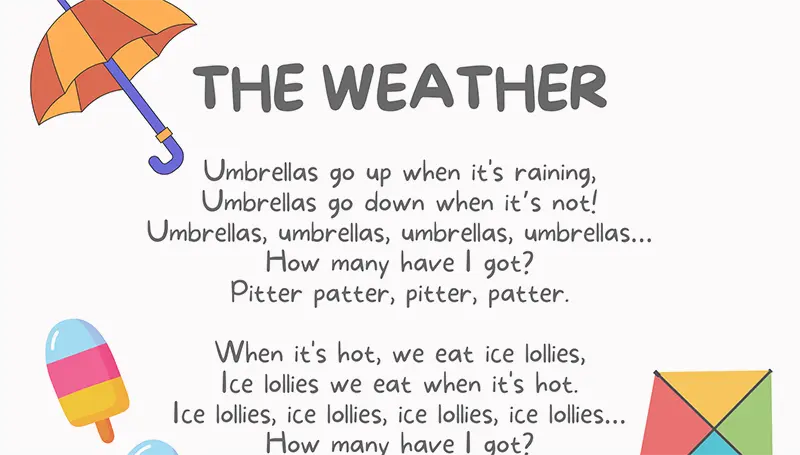
Have a classroom area where you leave out the resources linked to each song or rhyme, along with the written version of the rhyme. You can store each set in a basket or box and invite the children to decorate it so it becomes theirs.
Even if children can’t read yet, they will often use these materials during free play. This helps them understand that print carries meaning and encourages early literacy. Once children are familiar with the songs, you’ll often see them using the resources independently, sometimes singing just for pleasure.
It’s especially lovely to see less confident children surprise you during free play, quietly singing or “teaching” the rhyme to themselves or others when they feel no one is watching.
6. Songs and rhymes encourage active learning
When teaching Young Learners, it’s important to take a holistic approach and think about the whole child, not just the language. Songs and rhymes are ideal for this, as they often include actions that allow children to move while they are learning.
Action songs such as “Head, Shoulders, Knees and Toes” work particularly well. Children enjoy doing the actions, and at the same time they are absorbing the language naturally, without any pressure. The movement helps them remember the words and keeps them focused and engaged.
Children respond very positively when they are given the chance to move. Just remember to keep things calm and controlled – a quick reminder of your “stop” signal is usually all that’s needed to bring the energy back down again.
7. Songs and rhymes help develop pre-reading skills
Songs and rhymes play an important role in developing pre-reading skills. By listening to rhythm, sounds, and syllables, children are fine-tuning their ears. This supports listening and speaking skills and builds phonological awareness, all before formal reading begins.
8. Songs and rhymes bring language to life
When children say rhymes and sing songs, they hear and use English in a natural, meaningful way. There are no unnatural sentences or phrases with no clear purpose. Songs and rhymes allow children to experience how English really sounds, with rhythm, stress, and intonation.
9. Songs and rhymes help with cross-curricular learning
Songs and rhymes don’t only support language learning. They can also link to other areas of the curriculum.
For example, a song like “My Minibeast Friends” introduces vocabulary related to nature and movement, supporting “Understanding of the World”. Greeting songs help develop “Personal, Social and Emotional Development” and “Expressive Arts”.
(“My Minibeast Friends” is one of the songs in our Rhymes and Songs Pack for 3-5 Year Olds.)
10. Songs and rhymes show children how English works
Through songs and rhymes, children begin to notice how English works – its rhythm, stress patterns, vocabulary, and grammar – all presented in a fun and accessible way.
Final thoughts
Using songs and rhymes in your English lessons gives children a positive, memorable introduction to learning a new language. You can use them at any point in a lesson, or even build an entire lesson around them. Teaching English through songs and rhymes can genuinely change children’s learning experience, from something challenging to something enjoyable and confidence-building.
Why not simply give it a try and see the difference for yourself?
You can find our Rhymes and Songs Packs for Young Learners here.