

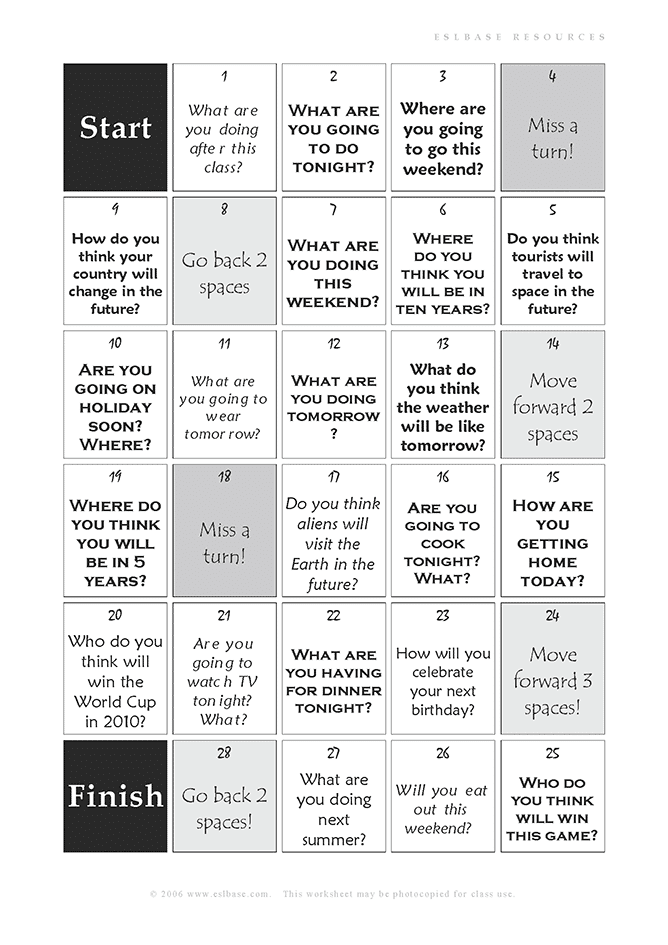
Looking for a fun way to practise different future forms in your ESL class? This free board game helps students review a range of future forms through questions and short conversations. It’s ideal for pre-intermediate and intermediate learners, and works well as a fluency activity, revision game, or end-of-lesson challenge.
The game prompts students to use forms like will and going to, and the present continuous in context, to build confidence and fluency.
Activity Overview
- Level: Pre-intermediate / Intermediate
- Target language: Future forms (e.g. will, going to, present continuous)
- Time: 20–30 minutes
- Group size: 3–4 students
What you need
- A copy of the board game for each group (download here)
- One counter per player
- One dice per group
How to play
- Divide students into groups of three or four.
- Give each group a board game, a dice, and one counter per player.
- Players place their counters on START and throw the dice to decide who begins.
- Player A throws the dice and moves forward that number of spaces.
- Player B asks the question on the square where Player A lands. Player A answers using an appropriate future form.
- If the group agrees the answer is correct, Player A stays on that square. If not, they return to their previous position.
- Encourage short follow-up questions or discussion to build fluency and check understanding.
- The first player to reach FINISH is the winner.
Why use this activity?
This board game provides a communicative way to practise different future forms in context. It’s especially helpful for reinforcing the differences between will, going to, and the present continuous. Students get repeated exposure to question forms and natural conversation.
Related grammar links
- Will and Going to – Learn how to form and use “will” and “going to”.
- Present continuous – Learn how to form and use present continuous to talk about future arrangements.
